«First Bank» ranking of the largest 100 Arab Banks as of the end of March 2026

FAB UAE Strengthens Its Position as the Largest Arab Bank; QNB Retains Second Place
Emirates NBD Climbs to Third Place as Saudi National Bank Slips to Fourth
UAE Banks Continue Regional Dominance with 18 Banks Holding 29% of Total Assets
Egyptian Banks Secure 10 Spots, Led by the National Bank of Egypt, Banque Misr, CIB, and Arab African International Bank
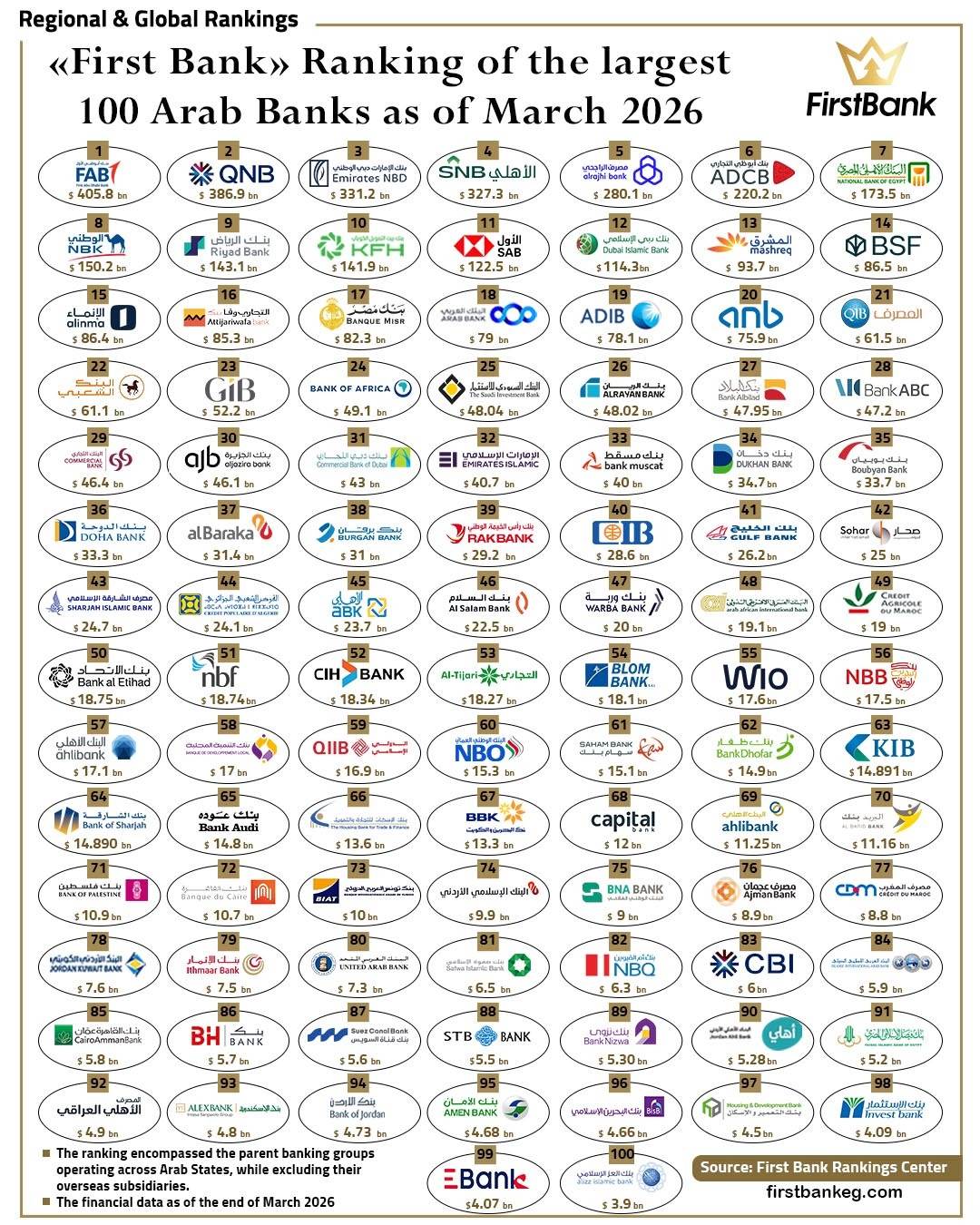
«First Bank» ranking of the Top 100 Arab Banks as of March 2026 revealed the continued dominance of the UAE banking sector, which topped the list with 18 banks and total assets of US$1.46 trillion, accounting for approximately 29% of the combined assets of the ranking. This reflects the strength and regional expansion of UAE banks.
Jordan ranked second in terms of the number of banks represented, with 11 banks, although they accounted for only 3.4% of the total assets, with combined assets reaching US$168.98 billion by the end of March 2026.
Egypt and Saudi Arabia each placed 10 banks in the ranking. However, Saudi banks significantly outperformed their Egyptian counterparts in asset size, with total assets reaching US$1.26 trillion, representing nearly 25% of the ranking’s total assets. Egyptian banks recorded combined assets of US$338.48 billion, accounting for 6.7% of the total.
The Kuwaiti banking sector was represented by nine banks, holding a 9.1% share of the total assets, with combined assets amounting to US$459.87 billion at the end of March 2026.
Meanwhile, Qatar, Bahrain, and Morocco each had eight banks featured in the ranking. Qatar led the three in terms of asset size, with its banks recording US$644.83 billion in total assets, equivalent to 12.8% of the list’s total assets.
Moroccan banks posted combined assets of US$267.86 billion, representing 5.3% of the total, while Bahraini banks held US$196.27 billion, accounting for 3.9% of total assets during the same period.
Oman was represented by seven banks, the lowest among the GCC countries in both the number of banks and asset size. Omani banks reported total assets of US$115.69 billion, representing only 2.3% of the total assets in the ranking.
Among countries with a limited presence—each accounting for less than 1% of total assets—Tunisia was represented by five banks, while Algeria and Lebanon each had two banks on the list. Palestine and Iraq each secured one spot.
The ranking was based on total assets reported as of the end of March 2026, converted into U.S. dollars to ensure a standardized comparison across banking institutions. Banks lacking officially disclosed financial data were excluded to preserve the accuracy and reliability of the ranking methodology.
Limited Changes Among the Top 10 Arab Banks
Changes within the Top 10 Arab Banks were relatively limited, Emirates NBD advanced to third place, overtaking Saudi National Bank, which slipped to fourth, compared with the December 2025 ranking.
Riyad Bank climbed to ninth place, while Kuwait Finance House moved down to tenth.
The remaining banks in the top ten maintained their previous positions, highlighting the stability of the Arab banking landscape during the first quarter of 2026.
Top 10 Arab Banks by Total Assets – March 2026
First Abu Dhabi Bank (FAB) ranked first, with total assets of US$405.78 billion at the end of March 2026.
Qatar National Bank (QNB) secured second place, with total assets of US$386.91 billion.
Emirates NBD ranked third, reporting assets of US$331.24 billion.
Saudi National Bank (SNB) came fourth, with total assets of US$327.34 billion.
Al Rajhi Bank ranked fifth, with assets totaling US$280.11 billion.
Abu Dhabi Commercial Bank (ADCB) placed sixth, with total assets of US$220.20 billion.
National Bank of Egypt (NBE) ranked seventh, with assets amounting to US$173.51 billion.
National Bank of Kuwait (NBK) secured eighth place, with total assets of US$150.17 billion.
Riyad Bank ranked ninth, reporting assets of US$143.11 billion.
Kuwait Finance House (KFH) completed the top ten with total assets of US$141.87 billion.
It is worth noting that the ranking covers parent banking groups across the Arab countries and does not include their foreign subsidiaries.