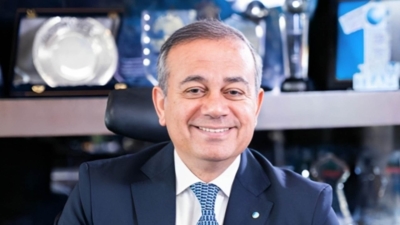
NBE consolidates its leadership under Mohamed El-Etreby

Leadership is often judged by a simple measure: how much an institution grows under management. At National Bank of Egypt (NBE), however, the benchmark is more demanding.
When Mohamed El-Etreby took the helm in early October 2024, he inherited not a bank seeking scale but Egypt’s largest lender, an institution whose size, reach, and responsibilities place it in a category of its own.
The challenge, therefore, was not to establish a leading position but to deepen it: expanding the bank’s operations while ensuring its infrastructure, resources, and capabilities kept pace with a growing balance sheet.
Viewed through this lens, the two-year record is less a story of growth than a measure of how effectively NBE has managed its scale and strengthened the capabilities needed to sustain it.
Financial position expands to record levels
According to the latest financial data, NBE’s total assets reached EGP 10.60tn at end-August 2026, up from EGP 7.39tn at end-September 2024, a 43.4 per cent increase, equivalent to EGP 3.21tn.
For Egypt’s largest bank, however, balance-sheet growth is only part of the measure. The more important question is how far that expansion translated into deeper core banking activity and a greater flow of loans to customers and key sectors of the economy.
From balance-sheet expansion to broader business activity
Loans provide the clearest evidence of that expansion translating into core banking activity. NBE’s loan portfolio climbed to EGP 5.80tn at end-August 2026, from EGP 3.64tn at end-September 2024, marking a growth of 59.3 per cent and an increase of EGP 2.16tn.
Corporate loans accounted for the bulk of the increase. Including small loans for economic activities, the portfolio rose to EGP 5.22tn at end-August 2026, from EGP 3.30tn at end-September 2025, up 58.4 per cent, or EGP 1.92tn.
Retail loans also expanded, reaching EGP 506bn at end-August 2026, from EGP 344.80bn at end-September 2024, an increase of approximately 46.7 per cent.
Deposits: the funding base behind expansion
As financing expanded, the focus shifts to the other side of the balance sheet, which is the funding base supporting that growth.
Customer deposits rose to EGP 6.40tn at end-August 2026, from EGP 4.69tn at end-September 2024, representing growth of 36.4 per cent.
Financing therefore outpaced deposit growth over the period, while customer deposits remained the principal source of funding underpinning NBE’s expanding balance sheet.
This movement does not, in itself, amount to a judgement on the efficiency of resource management. It does, however, show that the expansion in financing activity was accompanied by a broader deposit base, with financing growing at a faster pace.
The figures therefore point to a larger business base on both sides of the balance sheet: more resources on one side and greater financing on the other. This leads to the more important question: what did that expansion generate?
Profitability: what business expansion deliver?
On profitability, NBE recorded a net profit of EGP 175.49bn in 2025, compared with EGP 133.27bn in 2024, an increase of 31.7 per cent. These remain the bank’s latest disclosed profitability figures, with no results for a more recent period yet published.
Net Interest Income (NII) also rose to EGP 343.71bn in 2025, from EGP 278.02bn in 2024, representing growth of 23.6 per cent.
Net fee and commission income reached EGP 36.60bn in 2025, compared with EGP 26.91bn in 2024, an increase of 36 per cent.
Return on average assets (ROAA) stood at 2.02 per cent in 2025, compared with 1.99 per cent in 2024, while Return on Average Equity (ROAE) reached 28.69 per cent, compared with 32.08 per cent over the same period.
Capacity to absorb a larger business base
As NBE’s operations expanded, the focus shifts to whether its infrastructure and banking channels evolved sufficiently to support that scale.
The indicators point to substantial progress. Instant payment transactions through IPN and InstaPay rose to around 717 million in 2025, with a total value of EGP 2.87tn, compared with 333 million transactions worth EGP 1.5tn in 2024 — a 91 per cent increase in value.
The bank also expanded its physical payments infrastructure. Its ATM network reached 7,572 machines at end-2025, up from 7,232 a year earlier, while point-of-sale terminals increased to around 758,000 from 633,000.
Credit cards reached 1.9 million, while debit cards stood at 8.4 million.
That expansion extended beyond digital and payments channels. NBE’s domestic network exceeded 700 branches, offices and banking units, including around 38 electronic service branches, alongside an international presence in Johannesburg, Dubai, Addis Ababa, New York, Shanghai and Riyadh.
The expansion of NBE’s business base was matched by a broader operating platform and wider distribution network, strengthening the infrastructure needed to support its scale. This is a key part of assessing leadership at an institution of NBE’s size, even though the available channel comparisons are concentrated mainly in 2024 and 2025.
NBE deepens its leadership
Looking across the two-year record, the defining feature of Mohamed El-Etreby’s tenure is not the creation of a leadership position, but the continued development of one built over decades, supported by a broader set of capabilities and operating tools.
That growth has been anchored in NBE’s underlying model: a broad customer base, substantial institutional activity, extensive reach, and a steadily expanding banking platform.
Seen in this context, the past two years represent less a break with the bank’s long-term trajectory than a further extension of it, adding scale, deepening activity, and strengthening the foundations of its market leadership.
El-Etreby’s first two years at NBE should therefore be judged not only by the increase in headline figures but also by the bank’s ability to build on an already dominant position and broaden the platform supporting it.