Big Numbers Race: The Giants’ Race.. «Emirates NBD» Competes with «First Abu Dhabi Bank» for the Title of «Largest Bank in the UAE»
The banking scene in the United Arab Emirates is witnessing an escalating competition between the largest banking entities, driven by the expansion of business scope and the acceleration of growth rates over the past few years.
In this context, this episode of «Big Numbers Race» addresses the competition between First Abu Dhabi Bank and Emirates NBD for the title of «Largest Bank in the UAE». The indicators of this race reflect an increasing convergence in the sizes of the main financial portfolios, with the competition gradually shifting from traditional size superiority to a more balanced equation based on growth speed and efficiency in resource utilization.
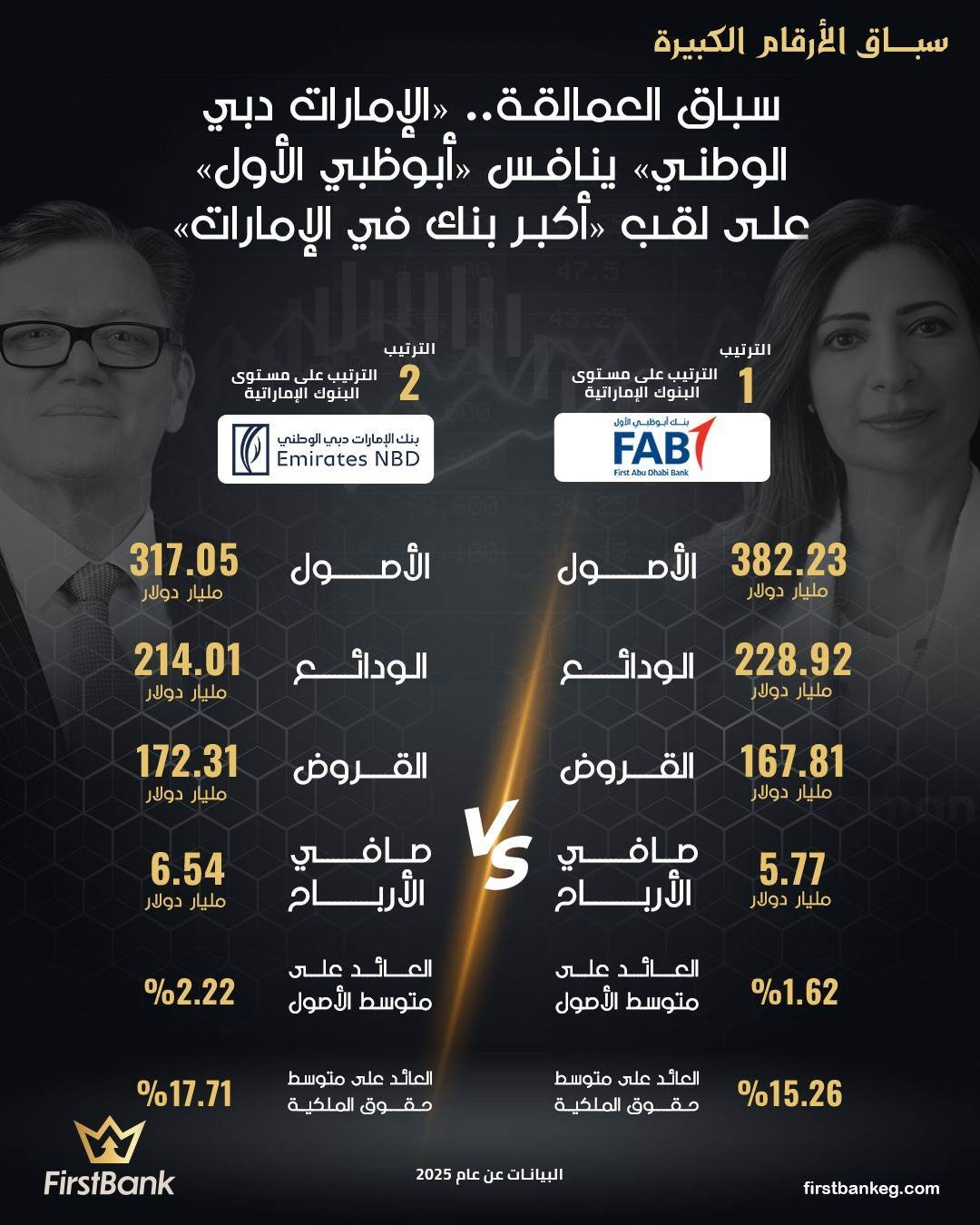
According to 2025 data, First Abu Dhabi Bank maintains its lead in the UAE banking sector in terms of total assets, which reached approximately 382.23 USD bn by the end of the year, compared to 317.05 USD bn for Emirates NBD at the end of the same year.
This superiority of First Abu Dhabi Bank also extends to deposits, where its portfolio reached approximately 228.92 USD bn by the end of 2025, compared to approximately 214.01 USD bn for Emirates NBD. This gives the former a relatively larger funding base.
In contrast, Emirates NBD shows a clear superiority in credit activity, with net customer loans reaching 172.31 USD bn by the end of 2025, compared to 167.81 USD bn for First Abu Dhabi Bank at the end of the same year. This reflects a denser utilization of liquidity in financing activities by Emirates NBD and indicates that it has adopted a more active expansionary strategy in lending compared to its competitor.
The features of the transformation in the competition map become clearer when analyzing growth rates over the last 3 years, specifically during the period from the end of 2022 to the end of 2025. Emirates NBD recorded growth in total assets of 56.9%, compared to only 26.4% for First Abu Dhabi Bank.
This led to narrowing the gap between the two banks from 100.24 USD bn at the end of 2022 to only 65.19 USD bn at the end of 2025.
The same pattern was repeated in deposits, where Emirates NBD achieved total growth of 56.3% over the last 3 years, compared to about 20% for First Abu Dhabi Bank during the same period. This contributed to reducing the gap in this item from 53.8 USD bn at the end of 2022 to only 14.91 USD bn at the end of 2025, which is a significant decline that reflects the acceleration of the latter’s ability to expand its funding base at a faster pace than its competitor.
On the financing level, net customer loans at Emirates NBD recorded growth of 51.9% over the last 3 years, compared to 34.1% for First Abu Dhabi Bank during the same period.
This acceleration in credit activity was reflected in the ranking of the two banks, as Emirates NBD managed to surpass its competitor in the volume of loans by the end of September 2025, while maintaining a limited difference of about 4.5 USD bn by the end of the year. This is a relatively small gap that reflects a significant convergence in lending positions.
The relative superiority of Emirates NBD is not limited to growth speed only, but also extends to profitability indicators, where the bank recorded net profits of 6.54 USD bn during 2025, outperforming First Abu Dhabi Bank’s profits of 5.77 USD bn during the same year.
«Emirates NBD» also achieved a return on average assets of 2.22% compared to 1.62% for «First Abu Dhabi Bank» during 2025.
In addition, «Emirates NBD» recorded a return on average equity of 17.71%, compared to 15.26% for «First Abu Dhabi Bank» during 2025, which indicates a relatively higher efficiency for the former in utilizing assets and shareholders’ equity to generate profits.
In contrast, First Abu Dhabi Bank still enjoys a clear advantage in terms of capital base, where its capital reached approximately 3 USD bn by the end of 2025, compared to approximately 1.72 USD bn for Emirates NBD at the end of the same year.
This larger capital base gives the bank higher flexibility in funding future expansion and absorbing shocks, which enhances its ability to maintain its leading position in the medium term.
These indicators suggest that the competition between the two giants of the UAE banking sector - First Abu Dhabi Bank and Emirates NBD - has entered a more balanced phase; where the former maintains the advantage in asset size, deposits, and capital base strength, while the latter is accumulating gradual superiority in credit activity, growth rates, and profitability.
This contrast between «size strength» and «growth momentum» creates an open competitive equation that may redraw the map of leadership in the UAE banking sector in the coming years.