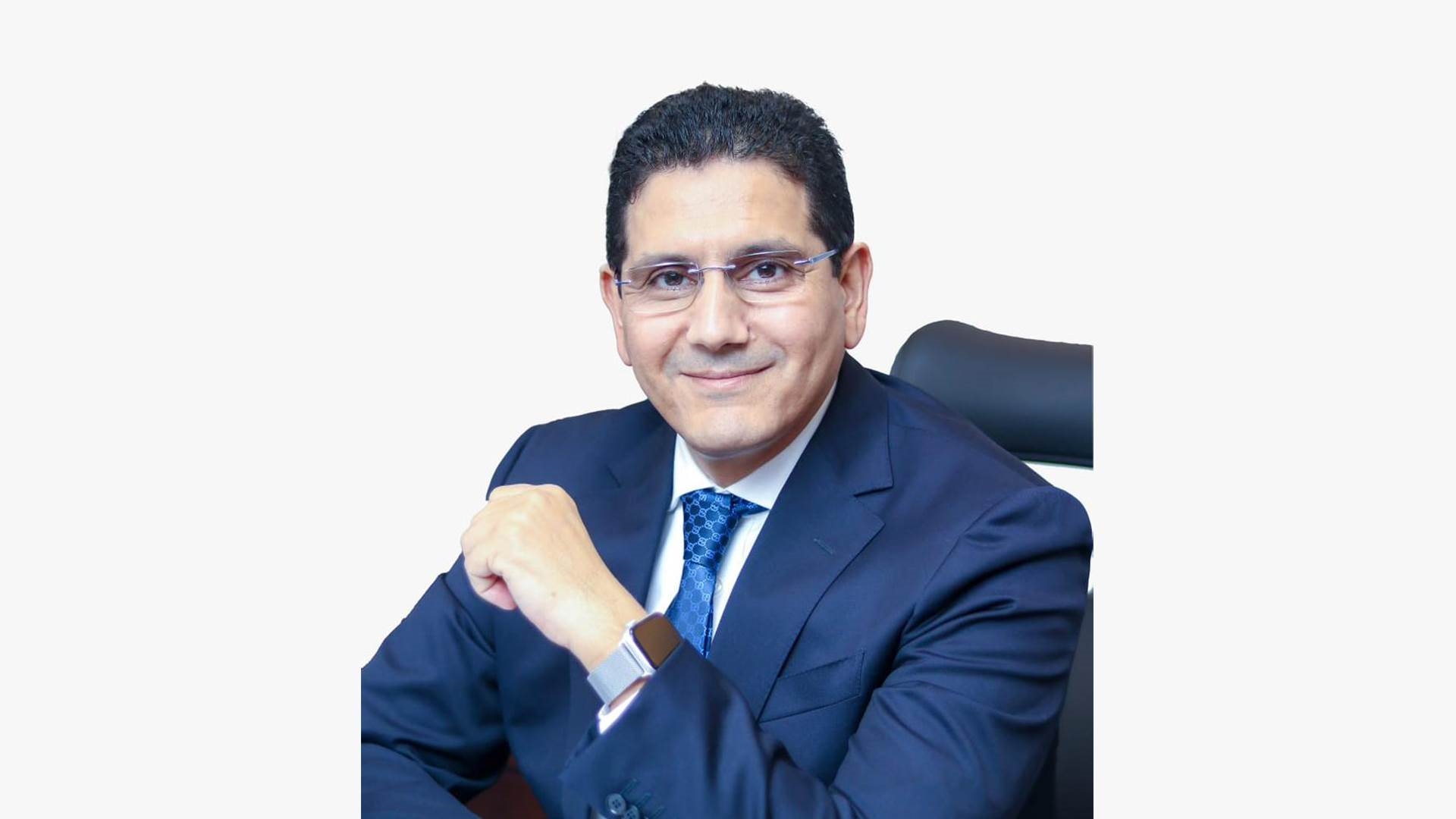
Mouawia Essekkelli steers Attijariwafa Egypt through 3 years of corporate-led growth
Shaimaa Nasser
Translated and edited by Aya Elsayed
Assets rose 170% between end-2022 and end-March 2026, while corporate clients drove most of the expansion in deposits and lending.
Attijariwafa Bank Egypt has significantly expanded its balance sheet since Mouawia Essekkelli took over as chief executive officer and managing director in December 2022, with growth increasingly concentrated in its corporate business.
More than three years into his tenure, the change extends beyond the bank’s growing scale. Corporate clients have become a larger component of both deposits and lending, while profitability and returns have also strengthened over the period.
Total assets rose 170 per cent to EGP 166.68 billion at end-March 2026, from EGP 61.71 billion at end-2022. The bank’s official Q1 2026 statement report total assets of EGP 166.68 billion.
Customer deposits reached EGP 140.71 billion at end-March 2026, broadly matching the pace of the bank’s asset growth over the period.
Corporate deposits lead funding growth
Deposit growth was concentrated in the corporate segment. Corporate deposits rose 199.9 per cent to EGP 91.57 billion at end-March 2026, from EGP 30.54 billion at end-2022, while retail deposits increased 123.6 per cent to EGP 49.14 billion, from EGP 21.97 billion.
Corporate deposits added about EGP 61.04 billion over the period, compared with EGP 27.17 billion for retail deposits. The increase in corporate deposits was equivalent to about 58 per cent of the total increase in the bank’s assets over the same period.
As a result, the corporate segment’s share of total customer deposits rose to about 65.1 per cent at end-March 2026, making it the largest component of the bank’s funding base.
Retail deposits, nevertheless, more than doubled, showing that the bank expanded its retail deposit base alongside the stronger growth in corporate funding.
Corporate lending accounts for most credit expansion
The shift towards corporate business was also evident in lending.
Loans and facilities to customers increased from EGP 32.18 billion at end-2022 to about EGP 72.17 billion at end-March 2026.
Corporate loans accounted for about 81 per cent of the total at end-March, reaching approximately EGP 58.42 billion, while retail loans stood at EGP 13.74 billion.
Corporate lending accounted for about 84 per cent of the increase in customer loans over the period, adding around EGP 33.45 billion.
The figures show that corporate clients became the main driver of both deposit and lending growth, while the retail business continued to expand alongside them.
Expansion feeds through to profitability
Loan portfolio quality remained high as the ratio increased to 99.4 per cent at end-March 2026 from 99 per cent at end-2022, indicating that lending growth was achieved while maintaining strong portfolio quality.
The balance-sheet expansion was accompanied by a sharp rise in earnings, with net profit increasing 238.2 per cent to EGP 3.51 billion in 2025 from EGP 1.04 billion in 2022, a gain of about EGP 2.47 billion.
Net interest income increased from EGP 2.62 billion in 2022 to EGP 6.85 billion in 2025, while net fee and commission income rose from EGP 491.6 million to about EGP 1.28 billion.
The increase therefore extended across both core interest income and fee-based income rather than being concentrated in a single revenue line.
Returns improve alongside balance-sheet growth
FirstBank calculations also show an improvement in profitability ratios over the period.
Return on average assets (ROAA) increased from 1.92 per cent in 2022 to 2.51 per cent in 2025, while return on average equity (ROAE) rose from 17.13 per cent to 26.41 per cent.
The improvement indicates that the bank generated higher returns from both its asset base and shareholders’ equity as the business expanded.
Attijariwafa maintained its earnings momentum in Q1 2026, recording net profit of EGP 820.99 million, while ROAA stood at 2.04 per cent and ROAE at 23.43 per cent.
Overall, Attijariwafa Bank Egypt’s growth under Essekkelli has extended beyond balance-sheet expansion. Corporate clients have become the main driver of deposit and lending growth, while the retail business has continued to expand.
At the same time, net profit, net interest income and fee and commission income have all risen strongly, alongside improved returns on average assets and equity. The period has therefore reshaped the bank’s growth mix while strengthening its ability to convert a larger business base into higher earnings and returns.