The Big Numbers Race: Stronger MAD lifts Attijariwafa past Banque Misr to 2nd in North Africa
Yasmin Elsayed
Translated & Edited by Aya Elsayed
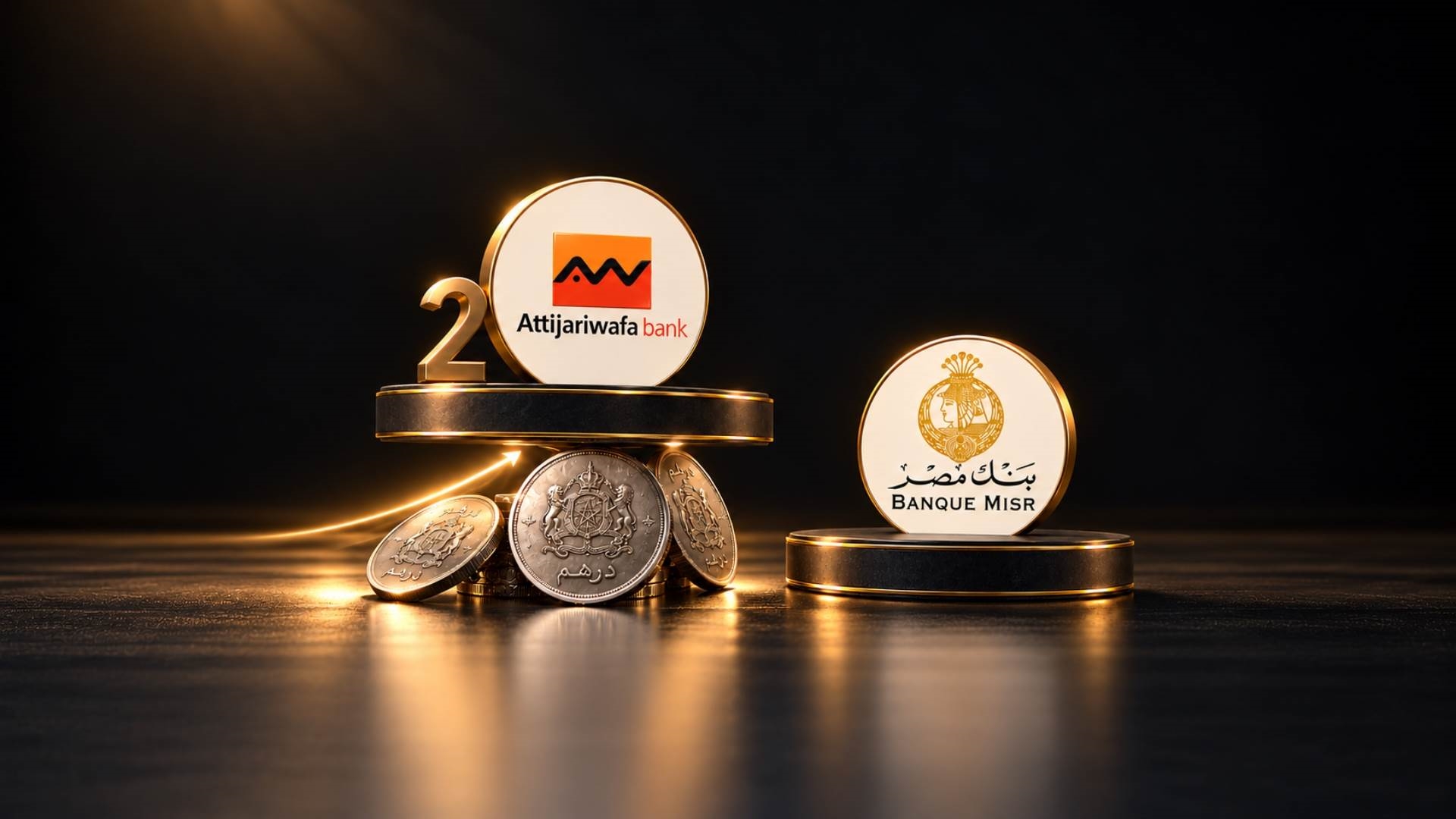
Attijariwafa bank overtook Banque Misr to become North Africa’s second-largest bank by total assets at end-June 2026, according to a recent First Bank analysis.
Its dollar-denominated assets reached USD 87.94bn, narrowly surpassing Banque Misr’s USD 87.34bn, marking a shift in the regional rankings despite a gap of just USD 600mn between the two institutions.
But was Attijariwafa bank’s advance driven by stronger underlying asset growth, or did exchange rate movements prove decisive?
A comparison of the banks’ performance from end-2022 to end-June 2026 reveals two contrasting trends, depending on whether asset growth is measured in local currencies or US dollars.
In dollar terms, Attijariwafa bank’s total assets rose 45.8 per cent to USD 87.94bn at end-June 2026, from USD 60.33bn at end-2022.
Banque Misr, by contrast, recorded a 2.7 per cent decline in its dollar-denominated assets, from USD 89.74bn to USD 87.34bn over the same period, allowing the Moroccan bank to secure second place.
The balance shifts considerably when asset growth is measured in each bank’s domestic currency.
Banque Misr recorded a 93.2 per cent increase in total assets, reaching EGP 4.29tn at end-June 2026, compared with EGP 2.22tn at end-2022.
Attijariwafa bank, meanwhile, reported growth of 30.9 per cent, with assets rising to MAD 825.30bn from MAD 630.42bn over the same period.
The figures reveal that Banque Misr achieved substantially faster asset growth in local currency terms, yet this expansion failed to translate into a stronger position when measured in US dollars.
The divergence highlights the extent to which exchange rate movements can reshape cross-border banking comparisons, even when underlying asset growth points in a different direction.
Currency movements played a significant role in the contrasting dollar valuations of the two banks.
Between end-2022 and end-June 2026, the Egyptian pound lost approximately 49.6 per cent of its value against the US dollar, reducing the dollar equivalent of Banque Misr’s expanding asset base.
The Moroccan dirham, by contrast, appreciated by approximately 11.3 per cent against the dollar, supporting the US dollar valuation of Attijariwafa bank’s assets.
Attijariwafa bank’s advance over Banque Misr, therefore, does not necessarily indicate stronger asset growth in local currency terms.
Rather, it reflects the combined influence of underlying asset expansion and exchange rate movements, which ultimately reshaped the relative positions of the two institutions when measured in US dollars.