First Bank: 10 Arab banks account for half of top 100 assets

First Bank’s ranking of the 100 largest Arab banks at end-June 2026 shows that financial strength remains heavily concentrated among a small group of major institutions, with the top 10 accounting for 50.37 per cent of the combined assets of all banks included in the ranking.
Total assets across the Arab top 100 reached approximately USD 5.17tn at end-June 2026, up from USD 4.98tn at end-2025, representing growth of around 4 per cent and an increase of USD 195.82bn during the first half.
The 10 largest banks alone held approximately USD 2.60tn in assets at end-June, compared with USD 2.51tn at end-2025, an increase of USD 96.63bn and growth of 3.9 per cent on a half-year basis.
Despite that expansion, the top 10’s share of total assets edged down to 50.37 per cent from 50.41 per cent, a decline of just 0.04 percentage points.
The movement is marginal and does little to alter the broader picture: the region’s 10 largest banks still control roughly half of the assets held by the Arab top 100.
The figures underline the degree of concentration at the top of the sector. While 10 institutions account for more than half of total assets, the remaining 49.63 per cent is spread across 90 banks, highlighting the wide disparity in scale across Arab banking.
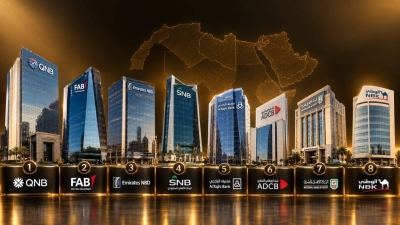
That concentration is reinforced by the size of the institutions at the top of the ranking. QNB held USD 394.72bn in assets at end-June 2026, followed by First Abu Dhabi Bank (FAB) at USD 383.57bn and Emirates NBD at approximately USD 360.08bn.
The implications extend beyond balance-sheet size. Larger banks benefit from greater capacity to expand lending and investment, build deeper deposit bases and sustain a stronger presence across the markets in which they operate.
Mid-sized and emerging institutions, by contrast, compete from smaller asset bases, making it more difficult to close the gap with the sector’s largest players.
The June 2026 data therefore point to an Arab banking landscape in which financial power remains firmly concentrated at the top. Banks outside the top 10 gained only marginal ground in relative terms, leaving the competitive balance between the region’s largest institutions and its mid-sized and emerging banks broadly unchanged.